
Please note that this course has been discontinued and only takes applicants for Level 6 entry directly into last year of study.
Overview
If you're interested in a practical and future-facing business education, with a focus on sustainable business practices, innovation and leadership, this is the course for you.
Whether you think of yourself as an agent of change, an entrepreneur or a business owner, or you aspire to manage and lead a large multinational company, you’ll acquire the knowledge, skills and confidence to create sustainable value and tackle the fast-moving global challenge of environmental change.
You’ll learn the fundamentals of sustainable organisations, resource management and business innovation, and the roles that businesses, government and civil society play in transitioning to sustainable models. You’ll also explore the moral, social and economic challenges emerging from global climate change and learn to navigate the complexities of people, organisations, systems and the planet.
Drawing on real case studies, you’ll gain an insight into different styles of leadership
and the practical tools needed to innovate and implement sustainable initiatives, globally. More importantly, you’ll gain the knowledge and skills needed make positive change as part of an ecosystem that includes you, others and the wider world.
You’ll graduate with the mindset, resilience and traits of a sustainable innovator and leader, ready to meet complex global challenges.
Learn in London – the UK's business hub
From global organisations to new start-ups, studying in London offers opportunities to engage with all aspects of the business arena – gaining valuable work experience and meeting influential industry contacts.
- Join workshops, focus groups and masterclasses
- Collaborate with academics researching sustainable futures and change initiatives
- Explore London’s start-ups and exhibitions including Sustainability LIVE
- Build proposals, construct business plans, explore laws, analyse cost implications
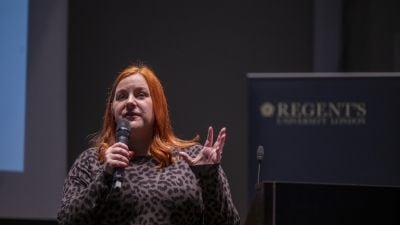
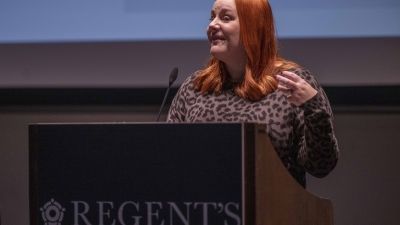
- Join industry talks: Harrods, McLaren Automotive, Mulberry, Meta, Burberry
- Burberry’s SVP of Group Finance explained how to develop a business strategy
- Mulberry’s Head of Sustainability showed how to integrate environmental goals
- Work on live briefs commissioned by industry experts
Optional Foundation year
If you opt for a Foundation year, you'll gain a solid grounding in academic skills and principles, as well as an introduction to your chosen subject area. It will provide a rich and varied experience to ensure you’re prepared for degree-level study in the UK – ready to develop specialist knowledge and confidently make the most of your course.
Download course specification.
How to apply
Applying to Regent's is quick and easy. We accept direct applications year-round and there's no application fee. If you haven't received your exam results, you can still apply and we'll issue you with a conditional offer. You just need be clear in your application which qualifications you're currently studying for.
Step 1: Apply
- On our website, details here
- Through UCAS (The Regent’s UCAS code is R18)
During the application process, you'll have the chance to upload supporting documents, including:
- A copy of your passport (photograph ID page)
- Academic transcripts and certificates from all previous studies
- A 300-500 word personal statement (view guidance)
- If you're not a native English speaker, proof of your English proficiency (take our test)
Credit transfer
If you’ve already studied part of your degree elsewhere, you may be able to apply for Recognition of Prior Learning (RPL) and join your new course at an advanced entry point. To apply for RPL, you'll need to state this clearly in your application and provide us with the certificates, transcripts and module descriptions for your previous course.
Step 2: Receive a response
You can expect to receive a decision on your application within 10 working days. We'll assess whether you meet our entry requirements and will notify you of our decision via email. UCAS applicants will also receive official notification via the UCAS system.
For some of our courses, the selection process may include an interview or audition. They can take the form of a one-to-one interview, a group interview or a portfolio review, which may be conducted by telephone or online. Arrangements of these are made between you and the Admissions department.
Step 3: Accept your offer
If you wish to accept your offer, you must pay your (non-refundable) advance tuition fee deposit. This will confirm your place. Here's how.
Step 4: Register
Closer to the start of term, our Admissions team will send instructions regarding your registration process. This will include information on completing your online enrolment before you arrive, as well as a checklist of documents you'll need to bring with you to campus.
Information for international students
If you're an overseas student, you'll likely require a visa to study in the UK. Here's how to apply.
There are a wide variety of funding and scholarship opportunities to help you finance your studies. For more information, please visit our scholarships and funding page.
Fees
Tuition fee:
- £27,750 per year for the intake starting in September 2026
Non-refundable advance deposit:
- UK students: £1,500
- Non-UK students: £5,000
Read more about tuition fees.
When do I need to pay?
If you receive an offer for a course, you’ll receive a pro forma invoice. To accept your offer and secure your place, pay your deposit payment as soon as possible.
The remaining portion of your first year’s tuition fees will be due when you enrol. At this time, you’ll receive your invoice for the full year. You can choose to pay for the year in full before the start of your first academic year or in two instalments, spread out across the academic year. The dates of these instalments will be determined by when your course starts.
What do fees include?
Fees cover the cost of all tuition and access to the University’s IT infrastructure and library learning resources. Fees are presented for the first level of study which equates to two terms.
What other costs should I budget for?
You will need to budget additional funds for accommodation and living expenses, travel, and any additional trips, visits, activities or courses that you choose to participate in outside of the tuition offered as part of your course.
The library holds a limited number of copies of core textbooks and where possible in e-format. You will be encouraged to purchase your own textbooks and will need to budget approximately £80-£100 per year, depending on your course.
How you'll learn
At Regent's, you’ll have the freedom to explore your interests in a dynamic, supportive and collaborative environment with interactive classes, industry opportunities, specialist facilities and tailored careers advice – ensuring you develop the skills, experience and confidence you need to secure your dream job.
You’ll pair academic knowledge with hands-on experiences – exploring current issues and proposing solutions to real challenges. Classes incorporate:
- Seminars and guest lectures
- Practical workshops and creative labs
- Group work, pitches, presentations
- Business bootcamps and simulations
- Live briefs and consultancy work`
Based in London, you'll also have opportunities to meet industry leaders and employers through guest lectures, live briefs, events and field trips.
Contact hours
You’ll have 14 hours per week of timetabled teaching. Outside your classes, you'll work on assignments both independently and collaboratively with classmates. This involves further reading, research and reflection, as well as preparation for workshops and assessments.
Teaching staff
You'll be taught by a mix of industry experts and research-active academics who have extensive global experience. They’ve published journals, books, news articles and magazine columns, appeared on documentaries and been quoted in outlets from Forbes to the Financial Times. They've also worked with brands including Meta, Microsoft and Coca Cola. Their knowledge and experience ensure classes are always shaped by the latest technologies and trends. You’ll also:
- Attend guest lectures with leading businesses and brands
- Be allocated an Academic Advisor, who you’ll meet with regularly on a one-to-one basis
Assessments
You’ll be assessed via projects, reports, plans, pitches, presentations and live and simulated briefs. It's important to us that your learning is inclusive, engaging and authentic – that’s why our assessment types are varied, dynamic and built around real-world ways of working.
Disability support
We welcome and support students with a wide range of disabilities and health concerns. Please speak to us as soon as possible, so we can provide the help you need.
Academic requirements: Year 1 entry
We're interested in your potential, as well as your prior achievements – and review each application comprehensively on its own merit.
One of the following qualifications:
- Three GCE A-levels at grade A-C
- 24 points in the International Baccalaureate
- US High School Diploma with a minimum GPA of 2.5 PLUS one of the following:
- Three AP tests with an average grade of 3 (or two, with an average grade of 4)
- SAT score of 1100 (550+ in both subjects)
- ACT with a composite score of 26 (20 in each section)
- Dual Enrolment and College credits (1st year) – 30, with a GPA of 2.5 or higher
- Equivalent qualifications as deemed acceptable by the University and set out in the Admissions Guide and UK ENIC.
English language requirements
Minimum English proficiency requirement through one of the following qualifications (or equivalent):
| Qualification | Subject | Grade |
|---|---|---|
| GCSE* | English language | C (4) |
| IB SL or HL* | English A | 4 |
| IB HL* | English B | 4 |
| US HSD (studied in a majority English-speaking country)* | Grade 11 and above English | C |
| IELTS* | Academic | 6.0 overall and 5.5 in each component |
Please note, we do not accept home/online editions of English language tests.
*Qualification satisfies the English language requirements of the UKVI for non-UK/Irish nationals.
We also offer conditional students a free, online, diagnostic test known as the Regent’s English Proficiency Test (REPT). This must be booked in advance. Discover more.
Student support
We welcome and support students with a wide range of disabilities and health concerns. This includes learning difficulties, visual and hearing impairments, mental health difficulties, autism spectrum conditions, mobility difficulties, and temporary or chronic health conditions.
Our Student Support & Welfare team is here to support you. We ask that you speak with us as early as you can to enable us to support you. Find out more about our disability support and contact us.
Careers
Graduates have gone on to manage and lead global teams in a range of industries (from luxury to non-profit, government, further education, etc) in roles such as:
- Business sustainability officer
- Business development manager
- Business sustainability analyst
- Sustainability and business consultant
- Sustainability planner
- Sustainability implementation specialist
- Economic development specialist
While this course often leads to graduates entering these professions, the transferable skills you develop will allow you to choose any career that aligns with your interests.
You could also use your degree as springboard to:
- Launch a start-up with sustainability at the heart
- Expand a family business
Graduate visa
After you've completed your course, you may be eligible to apply for a Graduate visa. This enables you to work, or look for work, in the UK for up to 18 months after you leave Regent's, without the pressure of having to secure a job immediately – applying your skills and advancing your career with valuable experiences and industry connections.
Careers support
Feeling overwhelmed about your career path? Our Careers team is here to provide tailored advice and support every step of the way, as well as lifelong access to invaluable resources.
- 24/7 access to online guidance and resources
- Exclusive internships, networking opportunities and industry events
- Personalised consultations – from interview and CV prep to business advice
- Access to Handshake, connecting you with 650k+ global employers
The Regent's Model
We've designed our curriculum for you – expanding your knowledge, skills, practice and thinking with three building blocks:
- Subject Core
- Special Electives
- Industry & Entrepreneurship
Read more about how you'll learn and view a complete list of Special Electives. Please note, all Special Elective modules are subject to availability.
View your academic calendar.
Year 1
Core modules
| Business and Sustainability | |
|---|---|
| Markets and Legal Frameworks |
This module develops your understanding of the legal implications and economic reasoning that underpins entrepreneurial and business activity. You will explore the relationship between business environments, markets and law and, in doing so, discover key aspects that inform business transactions. You will learn to understand how competitive consumer markets operate within the context of economics. By exploring the decision-making process and its impact on profits, you will develop an appreciation of how to gauge the macroeconomic performance of a country as well as how a legal system can impact on economic performance. This module also covers legal principles informing business transactions, commercial entities and consumer rights, the characteristics of a common law legal system and the contractual relationship. |
| Money, Finance and Decisions |
In this module, you will discover both theory and practical application of business techniques to come to successful and informed decisions. You will be exposed to approaches that satisfy professional standards, enabling you to learn how to use these tools to accomplish business goals. The professional analytical skills and techniques will support you in making better business decisions and presentations. This module will equip you with the knowledge and skills to make effective use of key budgeting, financial reporting, mathematical and statistical techniques applicable to business, finance and management. You will develop the ability and confidence to use numerical and problem-solving techniques and take advantage of information technology tools in the context of business and finance to enhance your future employability. |
| Sustainability Now |
What is the Anthropocene, and how did we enter a new geological era where humans have altered the Earth’s systems, from hydrologic to biospheric? In this module, you’ll learn to think from a holistic systems perspective about the cultural, social, historical, economic, environmental and geopolitical factors that have a human influence and impact on the natural environment. You’ll explore topics such as population growth, poverty, food production, energy security and waste, and ways in which climate impacts are unequally distributed across geographies, such as the global north and south divide. In the Anthropocene, it’s no longer business as usual, so what is the role of business, government and civil society in transitioning to new models for sustainable futures? |
| Sustainable Organisations | How can organisations provide sustainable solutions to the global challenges that we face? This module will allow you to explore how sustainability operates across the organisational ecosystem, from organisational culture to consumer behaviour. You’ll learn how sustainability intersects with key stakeholders in organisations, from customers and suppliers, to employees, industry and non-human actors. You’ll also consider what it means for organisations to be sustainable, what sustainable transition might look like, and how organisations have responded to sustainability agendas through concepts such as Corporate Social Responsibility (CSR) and the circular economy. |
| Learning Perspectives | This module will encourage you to become a collaborative, critical and reflective learner. Using the distinct lens of your course, you'll examine core questions about how and why we learn the way we do and develop skills essential for university study. |
Elective modules
| Choose two modules from the list below: | |
|---|---|
| London Perspectives | This interdisciplinary module will introduce you to the relationships between a range of subject areas, including your own academic specialism, and London. Subject areas addressed may include art, business, fashion, film, media, advertising, history, marketing, music, politics, psychology, religion, theatre and literature. You'll encounter specific contributions that London and Londoners have made to each of these fields, as well as consider how practitioners in each area have shaped the physical and intellectual landscape of the city that we know today – enabling you to explore the connections between your academic studies at Regent’s and the wider professional, cultural and civic contexts to which those studies contribute. |
| Global Perspectives | This module asks you to reflect on one of the most important questions we face: how can we work together to improve the communities we live in? You'll explore a range of contemporary intercultural, political, ethical and social issues that demand collective solutions – working in groups with students from different disciplines and from diverse cultural backgrounds to generate solutions to local dilemmas and global challenges. You'll be required to reflect on this process and develop your understanding of how teams work and how our individual contributions and choices affect the dynamics of the team. You'll consider the benefits of practising empathy and explore the increased potential for arriving at creative solutions when working with people who have different perspectives. |
| Language (Grades 1-6) – available Autumn and Spring |
Choose between Arabic, Chinese, French, German, Italian, Japanese, Russian and Spanish – all languages are offered from beginner to advanced level in every term. Languages provide you with tools to understand and imagine new worlds and communicate with others. Learning a language opens the door to cultures beyond your own and allows you to bridge the gap between communities and build connections for your life and your career. At Regent’s, you will learn languages differently. You will learn in a highly practical way, in order to develop skills for authentic communication. At Regent’s, you will receive individual attention in a supportive atmosphere and learn through collaboration and innovative teaching methodologies. Whether you want to start learning a new language, develop existing proficiency or prepare yourself to study abroad, these modules will help you develop a multilingual identity. |
| Advanced Language for Professionals (Grade 7) – available Autumn or Spring |
If you want to work in international or multilingual environments and you already have a higher intermediate level of Arabic, Chinese, French, German, Italian, Japanese, Russian or Spanish, this module is for you. You will learn to apply your existing language skills to the workplace and acquire the practical and linguistic tools to connect, collaborate and communicate effectively in multicultural professional settings. Learning in small groups, you will gain knowledge of the countries where the language is spoken and of their work practices and will apply that knowledge to tasks that resemble those in the workplace. You will also develop job-specific linguistic and cross-cultural skills and explore contemporary forms of communication at professional levels. Immersed in a unique classroom environment that embodies Regent’s cosmopolitan character, you will experience individual attention in a supportive atmosphere, learn through innovative teaching methodologies and develop your multilingual professional identity. |
| Advanced [Language] and Culture (Grade 8) – available Autumn or Spring |
This module is designed for students with a higher‑intermediate level of Arabic, Chinese, French, German, Italian, Japanese, Russian or Spanish who wish to advance their linguistic skills while deepening their understanding of the sociocultural realities of the communities where the language is spoken. You'll engage critically with contemporary and authentic written and multimodal texts (newspapers, social media outputs, films, podcasts, etc.) to develop your ability to interpret language in context and understand cultural references, viewpoints and communication styles across diverse social and historical environments. Drawing on the insights gained from these texts, you'll analyse and debate current cultural issues and public discussions to enhance your understanding of the sociocultural reality across the target language geographical area. Working collaboratively and with personalised support, you'll strengthen your multilingual identity and gain the linguistic, analytical and discursive tools needed to articulate and evaluate complex cultural ideas in the target language with greater nuance and cultural awareness. The typical exit language level on this module is equivalent to CEFR B2.2 (Common European Framework Reference for Languages). |
| Business English: Professional Writing – available Autumn or Spring |
Every professional journey will benefit from enhanced writing skills allowing you to express yourself and persuade others. Classes provide opportunities to create written texts (such as work emails, letters, proposals and reports) while developing understanding of writing as a process and how to adapt writing for diverse audiences and purposes. At the same time, you will also consider the impact of choices around tone, style, formality and other key language aspects. This module offers a memorable experience of professional writing, harnessing technology use (such as digital word lists, text analysers) and formative feedback, all within a supportive classroom atmosphere. As a result, you will be ready to apply what you learn to tasks on this module in your university course your career. |
| Business English/Advanced Business English – available Autumn or Spring |
For every prospective 21st century professional, higher-level business English skills are indispensable. Whether you study acting or psychology, business or fashion design, this module will develop business English knowledge (grammar and vocabulary) and skills (listening, speaking, reading and writing) at upper-intermediate and advanced levels, to enhance your fluency, persuasiveness and effectiveness as a global communicator. Classes provide opportunities to engage in motivating linguistic challenges (such as discussions, presentations and reports). You will select and introduce business topics of interest and enjoy multiple opportunities for formative feedback, all within a small group, supportive classroom atmosphere. The sessions will encourage you to reflect throughout, helping to improve confidence through tasks designed to showcase the full range of business English skills required for success in your future career. |
Year 2
Core modules
| Business and Sustainability | |
|---|---|
| Change and Resource Management |
All species need resources to sustain their existence, development and growth. As humans, we live in resource constrained societies, whether that’s related to our use of natural resources, economic resources, social or cultural resources. As part of a multispecies ecosystem, we live within a constrained planetary resource. In this module, you’ll learn about resource management through the lens of interdependence between humans and species. How can ‘we’ cooperate and build better together? How do we partner with the wider ‘world’ to build communities and business eco-systems for the future? You’ll use concepts such as Natural Capital, Circular Economy, Doughnut Economy and Regenerative Mindsets to understand how to improve efficiencies, reduce costs, innovate and add competitive advantage, while creating sustainable value and positive social impact. |
| Sustainability in Action |
How do businesses put sustainability into action and be transparent and accountable in the way that they operate? In this module, you’ll explore how sustainable thinking turns into action at different levels of industry and society – from the level of the organisation itself, to business consortiums, international organisations such as the World Bank, or at a global level like the UN Climate Change Conference (COP). You’ll consider where voices from the edges – NGOs, activists, indigenous cultures – contribute to, and radically challenge, these corporate, national and global agendas. Using business ethics as a starting point, you’ll learn about the different ways that businesses, governments and global governance bodies set standards for accountability and measure the actions and impact of organisations – covering topics such as Environmental, Social and Governance (ESG), Human Rights, and Sustainable Development Goals (SDG). |
| Sustainable Operations |
In resource-based businesses, strategic advantage is often underpinned by strong business operations and supply chains, which enable us to leverage information and technology to competitively manage customer service, costs and cash to maximise value. Sustainable operations today relates to the responsible management of all people, resources and processes (including their indirect impacts) that create, supply and renew the services and products of an organisation or function. This module emphasises the core theme of sustainability, which addresses the economic, social, and environmental aspects of operations over time as well as the role of advancing systems technology. As such, the module will empower you to examine and apply heuristics and systems thinking to the strategic development of the operations of a business you choose. It will equip you with the skills to practically progress operations through analysis and reflection of information that supports socially, environmentally and economically sustainable decisions. |
Elective modules
| Choose one module from each of the following categories, four in total: | |
|---|---|
| Elective module 1 | You can choose from: Creativity and Imagination; Being Human; Creating a Brand Identity; Why We Post: Social Media and Us; Financial Innovation and Technology; Photography Workshop; How to Think in a Post-Truth World; Understanding Human Rights; Literary London; Behind the Lens: Introduction to Media Production; Psychology of Emotions; London as Fashion Capital; Emerging Technologies: from Web3 to the Metaverse; Digital Design with Adobe Creative Suite; The Power of Language in Your Life; Business Ethics; Experiencing Theatre; Understanding the Global Art Market; Inspiring Your Audience; Future Cities Now. Scroll to the top of the page to find a link to the complete list and module descriptions. Please note, not all electives will be offered every term, due to timetabling and other constraints. |
| Elective module 2 | You can choose from: Creativity and Imagination; Being Human; Creating a Brand Identity; Why We Post: Social Media and Us; Financial Innovation and Technology; Photography Workshop; How to Think in a Post-Truth World; Understanding Human Rights; Literary London; Behind the Lens: Introduction to Media Production; Psychology of Emotions; London as Fashion Capital; Emerging Technologies: from Web3 to the Metaverse; Digital Design with Adobe Creative Suite; The Power of Language in Your Life; Business Ethics; Experiencing Theatre; Understanding the Global Art Market; Inspiring Your Audience; Future Cities Now. Scroll to the top of the page to find a link to the complete list and module descriptions. Please note, not all electives will be offered every term, due to timetabling and other constraints. |
| Elective module 3 or a Language | You can choose from: Creativity and Imagination; Being Human; Creating a Brand Identity; Why We Post: Social Media and Us; Financial Innovation and Technology; Photography Workshop; How to Think in a Post-Truth World; Understanding Human Rights; Literary London; Behind the Lens: Introduction to Media Production; Psychology of Emotions; London as Fashion Capital; Emerging Technologies: from Web3 to the Metaverse; Digital Design with Adobe Creative Suite; The Power of Language in Your Life; Business Ethics; Experiencing Theatre; Understanding the Global Art Market; Inspiring Your Audience; Future Cities Now. Please note, not all electives will be offered every term, due to timetabling and other constraints. — — — Or select a language module. You can choose between Arabic, Chinese, French, German, Italian, Japanese, Russian, Spanish and Business English – all languages are offered from beginner to advanced level. — — — Scroll to the top of the page to find a link to the complete list of Special Electives and Languages you can choose from. |
| Elective module 4 or a Language | You can choose from: Creativity and Imagination; Being Human; Creating a Brand Identity; Why We Post: Social Media and Us; Financial Innovation and Technology; Photography Workshop; How to Think in a Post-Truth World; Understanding Human Rights; Literary London; Behind the Lens: Introduction to Media Production; Psychology of Emotions; London as Fashion Capital; Emerging Technologies: from Web3 to the Metaverse; Digital Design with Adobe Creative Suite; The Power of Language in Your Life; Business Ethics; Experiencing Theatre; Understanding the Global Art Market; Inspiring Your Audience; Future Cities Now. Please note, not all electives will be offered every term, due to timetabling and other constraints. — — — Or select a language module. You can choose between Arabic, Chinese, French, German, Italian, Japanese, Russian, Spanish and Business English – all languages are offered from beginner to advanced level. — — — Scroll to the top of the page to find a link to the complete list of Special Electives and Languages you can choose from. |
Year 3
Core modules
| Business and Sustainability | |
|---|---|
| Disruptive Strategies and Models |
In an increasingly connected and turbulent world, it’s essential for organisations to be able to respond to change strategically. Strategy is about helping organisations understand what’s going on outside and inside the organisation, where they want to be in the future and how they get there. Organisations evolve business models that optimise the needs of current customers, balancing resources and capabilities with market demands. However, this can overlook the impact of potential new technologies and approaches. Today, disruptive technologies (for example blockchain and nanotechnology) are fundamentally challenging the business models within many industries. In this module, you’ll explore how organisations can harness technologies to disrupt and create new business models. You’ll develop the confidence to think strategically, distil the frenzy and identify new and profitable opportunities. It will expose you to the latest strategic approaches so you can think more creatively, innovate and adapt by considering how businesses can create, capture value and disrupt. |
| Sustainable Leadership |
As ESG rises to the top of shareholder, employee and government demands, businesses need to respond with new strategies for sustainable leadership. Whether you become Chief Sustainability Officer in a large corporate, or found a sustainable enterprise, you’ll need to deal with complexity and strategic decision-making. In this module, you’ll develop your own sustainable leadership methodology through exploring topics such as sustainable value creation, disruptive innovation, stewardship and social enterprise. You’ll become business-ready as a future leader with the skills, knowledge, resilience and entrepreneurial mindset to meet the social, environmental and economic challenges of 21st century business. |
| Major Project l |
The Major Project is the culmination of your studies. You will study Major Project I in the first term of your final year and Major Project II in the second. Each module comprises 20 credits. Together, the two modules form one project. The Major Project is a substantial piece of work, drawing on your discipline-specific and interdisciplinary learning, together with your learning about industry and entrepreneurship. You will have the freedom to design a self-directed project that reflects your interests and career aspirations. You may also choose to relate your Major Project to work you’re completing on your other final year modules. In Major Project I, you will start the term developing a proposal for your Major Project, supported by your tutors. Following your proposal, you will begin work on your Major Project, learning through individual or group supervision, workshops or studio practice, as appropriate to your project. |
| Major Project II |
Major Project II is the second Major Project module in your final year. Following the research and development you undertook in Major Project I, you will realise and complete your work in Major Project ll. The Major Project is your opportunity to apply your discipline-specific and interdisciplinary learning, together with your learning around industry and/or entrepreneurship to a topic of your choice. Through the Major Project, you can realise your ambitions as you prepare to graduate with work that illustrates your aspirations. You will learn through individual or group supervisions, workshops or studio practice, as appropriate to your project. You may also choose to relate your Major Project to the work you’re completing on your other final year modules. If you are working on an entrepreneurial project for your Major Project, you may be able to join the Founders Programme, which supports students and graduates interested in starting their own business with tailored guidance, coaching, mentoring, and access to experiential bootcamps and live events. |
Elective modules
| Choose one module from each of the following categories, four in total: | |
|---|---|
| Elective module 1 | You can choose from: Creative Futures; Essential Leadership Skills; Brand Me; Influencer Marketing Masterclass; The Blockchain and Cryptocurrency Revolution; How to Create a Social Enterprise; How to deal with Uncertainty; Understanding the Politics of Migration; Living Religions in London; Podcasting Masterclass; Exploring Sleep and Dreaming; Material Cultures and Sustainability; Understanding Artificial Intelligence; Professional Project Management; Introduction to Environmental Law; The Art of Data Storytelling; Cyber-psychology: Understanding Digital Behaviour; Decision-making Strategies Masterclass; Creative and Professional Writing Masterclass; Global Conflict and the Arts. Scroll to the top of the page to find a link to the complete list and module descriptions. Please note, not all electives will be offered every term, due to timetabling and other constraints. |
| Elective module 2 | You can choose from: Creative Futures; Essential Leadership Skills; Brand Me; Influencer Marketing Masterclass; The Blockchain and Cryptocurrency Revolution; How to Create a Social Enterprise; How to deal with Uncertainty; Understanding the Politics of Migration; Living Religions in London; Podcasting Masterclass; Exploring Sleep and Dreaming; Material Cultures and Sustainability; Understanding Artificial Intelligence; Professional Project Management; Introduction to Environmental Law; The Art of Data Storytelling; Cyber-psychology: Understanding Digital Behaviour; Decision-making Strategies Masterclass; Creative and Professional Writing Masterclass; Global Conflict and the Arts. Scroll to the top of the page to find a link to the complete list and module descriptions. Please note, not all electives will be offered every term, due to timetabling and other constraints. |
| Elective module 3 or a Language | You can choose from: Creative Futures; Essential Leadership Skills; Brand Me; Influencer Marketing Masterclass; The Blockchain and Cryptocurrency Revolution; How to Create a Social Enterprise; How to deal with Uncertainty; Understanding the Politics of Migration; Living Religions in London; Podcasting Masterclass; Exploring Sleep and Dreaming; Material Cultures and Sustainability; Understanding Artificial Intelligence; Professional Project Management; Introduction to Environmental Law; The Art of Data Storytelling; Cyber-psychology: Understanding Digital Behaviour; Decision-making Strategies Masterclass; Creative and Professional Writing Masterclass; Global Conflict and the Arts. Scroll to the top of the page to find a link to the complete list and module descriptions. Please note, not all electives will be offered every term, due to timetabling and other constraints. — — — Or select a language module. You can choose between Arabic, Chinese, French, German, Italian, Japanese, Russian, Spanish and Business English – all languages are offered from beginner to advanced level. — — — Scroll to the top of the page to find a link to the complete list of Special Electives and Languages you can choose from. |
| Elective module 4 or a Language | You can choose from: Creative Futures; Essential Leadership Skills; Brand Me; Influencer Marketing Masterclass; The Blockchain and Cryptocurrency Revolution; How to Create a Social Enterprise; How to deal with Uncertainty; Understanding the Politics of Migration; Living Religions in London; Podcasting Masterclass; Exploring Sleep and Dreaming; Material Cultures and Sustainability; Understanding Artificial Intelligence; Professional Project Management; Introduction to Environmental Law; The Art of Data Storytelling; Cyber-psychology: Understanding Digital Behaviour; Decision-making Strategies Masterclass; Creative and Professional Writing Masterclass; Global Conflict and the Arts. Scroll to the top of the page to find a link to the complete list and module descriptions. Please note, not all electives will be offered every term, due to timetabling and other constraints. — — — Or select a language module. You can choose between Arabic, Chinese, French, German, Italian, Japanese, Russian, Spanish and Business English – all languages are offered from beginner to advanced level. — — — Scroll to the top of the page to find a link to the complete list of Special Electives and Languages you can choose from. |


