
Apply now
Learn more


Design with purpose and intention to create spaces that shape lives and futures.
Architecture is the art and science of designing and constructing buildings – balancing creative vision with practical needs like cost, functionality, and longevity. But it goes far beyond physical structures. It shapes how we live, work, and interact with the world around us, and tackles some of society’s most urgent challenges – from climate and housing crises to urban inequality and the increasing demand for more sustainable and inclusive designs.
This creative course gives you a deep understanding of built spaces and how to design for people and their needs. You’ll develop skills through real briefs, taught by expert practitioners and industry experts, collaborate with local clients and communities, and gain entrepreneurial skills that empower you to turn your ideas into impactful, market-ready solutions.
Discover more about what makes Regent's special.
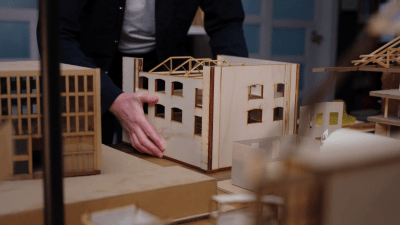
Set within the unique landscape of royal Regent’s Park in central London, surrounded by some of the world’s most famous landmarks and creative firms, this course has been designed to cultivate the next generation of architectural thinkers, designers, and leaders – empowered to drive change and create meaningful spaces that respond to the challenges of today and tomorrow.
It’s built around a dynamic studio culture that fosters experimentation, interdisciplinary collaboration and a strong sense of community. Working alongside peers from Architecture, Interior Design and other creative disciplines on shared modules and projects, you’ll quickly start to exchange ideas, challenge assumptions and broaden your design perspective. On campus, you’ll have access to:
From day one, you’ll work on live projects – responding to real briefs that reflect professional practice and engaging directly with clients, users, and communities. You’ll gain skills in drawing, model-making, concept development, storytelling, project management and budgeting, while becoming confident in using emerging technology like AI and digital fabrication to bring your ideas to life, and strengthen your pitches and proposals.
With the built environment responsible for nearly 40% of global carbon emissions, there’s increasing demand for architects who can design sustainably, ethically and innovatively. Throughout your studies, we’ll explore how to respond to the evolving climate emergency through informed decisions and zero-carbon strategies – aligning with the Royal Institute of British Architects (RIBA) Graduate Attributes and the University’s B Corp certification.
During your time at Regent's, you’ll learn from academics and industry professionals at the forefront of their fields – gaining insights into industry shifts while making valuable connections. You’ll also have opportunities to attend guest talks, workshops, site visits and study trips (locally and internationally) to expand your outlook and ground your learning in real examples and contexts.
In your second and third years, you'll have the chance to tailor your experience with a choice of elective modules, enabling you to pursue your individual interests and develop your own design identity.
You’ll leave Regent’s with a sophisticated portfolio and a deep understanding of the social, cultural, and environmental responsibilities of the sector. You’ll be able to communicate visually and spatially and imagine bold solutions to complex problems – skills that are valuable far beyond traditional architecture roles. You’ll feel well-prepared to enter architectural firms and agencies in the UK and internationally, pursue postgraduate study towards RIBA/ARB qualifications, or branch into related careers like interior architecture and spatial design.

London is one of the world’s greatest architectural capitals – where centuries of history meet cutting-edge innovation. It’s home to some of the most influential firms, practices, and thinkers in the field, as well as major architectural landmarks, design museums, and galleries. Studying in the city also gives you direct access to industry events, placement opportunities, and a vibrant network of professionals and creatives. Study trips might include:
This course isn’t currently validated by the Royal Institute of British Architects (RIBA), however, we plan to apply this year. This is the first formal step in the validation process. RIBA validation is based on evidence and includes external review of student work. If everything progresses successfully through RIBA’s exploratory and initial visiting boards, initial validation is expected around the 2029–30 academic year, after the first cohort graduates in summer 2029.
If validation is granted, it may be applied retrospectively. In practice, this means graduates from the first cohort could still be recognised as having achieved RIBA Part 1 – provided a RIBA visiting board confirms their work meets the required Themes & Values and Graduate Attributes, and that cohort-wide criteria are satisfied.
That said, because validation relies on external assessment and academic evidence, it isn’t guaranteed. We will, of course, keep applicants and students updated as things progress. It’s also worth noting that RIBA validation sits alongside the official registration pathway overseen by the Architects Registration Board.
We put you in the driving seat – shaping your education from day one:
Download course specification.
Course is subject to validation from the Royal Institute of British Architects (RIBA).
In your Foundation year, you'll gain a solid grounding in academic skills and principles, as well as an introduction to your chosen subject area. It will provide a rich and varied experience to ensure you’re prepared for degree-level study in the UK – ready to develop specialist knowledge and confidently make the most of your course.
Some modules will be taken with students heading towards the same or related subject areas, while others will be taken with a blend of students – enabling you to mix with peers who bring a range of different perspectives and experiences to the classroom. You’ll take two modules related to your subject area and eight shared modules covering key skills like communication, critical thinking, cultural understanding, politics, data, creativity and entrepreneurship.
Once you’ve successfully completed your Foundation year, you’ll directly progress to Year 1 of your chosen degree-level course.
Applying to Regent's is quick and easy. We accept direct applications year-round and there's no application fee. If you haven't received your exam results, you can still apply and we'll issue you with a conditional offer. You just need be clear in your application which qualifications you're currently studying for.
During the application process, you'll have the chance to upload supporting documents, including:
Credit transfer
If you’ve already studied part of your degree elsewhere, you may be able to apply for Recognition of Prior Learning (RPL) and join your new course at an advanced entry point. To apply for RPL, you'll need to state this clearly in your application and provide us with the certificates, transcripts and module descriptions for your previous course.
You can expect to receive a decision on your application within 10 working days. We'll assess whether you meet our entry requirements and will notify you of our decision via email. UCAS applicants will also receive official notification via the UCAS system.
For some of our courses, the selection process may include an interview or audition. They can take the form of a one-to-one interview, a group interview or a portfolio review, which may be conducted by telephone or online. Arrangements of these are made between you and the Admissions department.
If you wish to accept your offer, you must pay your (non-refundable) advance tuition fee deposit. This will confirm your place. Here's how.
Closer to the start of term, our Admissions team will send instructions regarding your registration process. This will include information on completing your online enrolment before you arrive, as well as a checklist of documents you'll need to bring with you to campus.
If you're an overseas student, you'll likely require a visa to study in the UK. Here's how to apply.How to apply
Applying to Regent's is quick and easy. We accept direct applications year-round and there's no application fee. If you haven't received your exam results, you can still apply and we'll issue you with a conditional offer. You just need be clear in your application which qualifications you're currently studying for.
During the application process, you'll have the chance to upload supporting documents, including:
Credit transfer
If you’ve already studied part of your degree elsewhere, you may be able to apply for Recognition of Prior Learning (RPL) and join your new course at an advanced entry point. To apply for RPL, you'll need to state this clearly in your application and provide us with the certificates, transcripts and module descriptions for your previous course.
You can expect to receive a decision on your application within 10 working days. We'll assess whether you meet our entry requirements and will notify you of our decision via email. UCAS applicants will also receive official notification via the UCAS system.
For some of our courses, the selection process may include an interview or audition. They can take the form of a one-to-one interview, a group interview or a portfolio review, which may be conducted by telephone or online. Arrangements of these are made between you and the Admissions department.
If you wish to accept your offer, you must pay your (non-refundable) advance tuition fee deposit. This will confirm your place. Here's how.
Closer to the start of term, our Admissions team will send instructions regarding your registration process. This will include information on completing your online enrolment before you arrive, as well as a checklist of documents you'll need to bring with you to campus.
If you're an overseas student, you'll likely require a visa to study in the UK. Here's how to apply.
There are a wide variety of funding and scholarship opportunities to help you finance your studies. For more information, please visit our scholarships and funding page.
Tuition fee:
Non-refundable advance deposit:
Read more about tuition fees.
When do I need to pay?
If you receive an offer for a course, you’ll receive a pro forma invoice. To accept your offer and secure your place, pay your deposit payment as soon as possible.
The remaining portion of your first year’s tuition fees will be due when you enrol. At this time, you’ll receive your invoice for the full year. You can choose to pay for the year in full before the start of your first academic year or in two instalments, spread out across the academic year. The dates of these instalments will be determined by when your course starts.
What do fees include?
Fees cover the cost of all tuition and access to the University’s IT infrastructure and library learning resources. Fees are presented for the first level of study which equates to two terms.
What other costs should I budget for?
You will need to budget additional funds for accommodation and living expenses, travel, and any additional trips, visits, activities or courses that you choose to participate in outside of the tuition offered as part of your course.
The library holds a limited number of copies of core textbooks and where possible in e-format. You will be encouraged to purchase your own textbooks and will need to budget approximately £80-£100 per year, depending on your course.
You will also need to purchase equipment and materials for this course, including sketchbooks, journals, model making materials and equipment. You will have access to printing on campus, yet may, at times, need to outsource this (e.g., for booklets or posters) and there may be an additional cost. The 3D workshops will provide some basic materials and tools for model making, at a limited availability, and students are encouraged to explore and find suitable materials to work with.
Whilst studying, you will have access to the latest learning technology and software to enhance your experience. You may prefer to have your own laptop, however, this is not a requirement as you can use our dedicated CAD lab facilities. Should you wish to purchase a laptop, we recommend either a MAC or PC that is able to run CAD/Photoshop software.
The course includes a rich offering of study trips in and around London. You will need to pay for travel around London, but most entrance fees for exhibitions and other London-based activities will be included in the course.
The course also includes study trips to other locations in the UK and internationally. For these study trips, the University pays for travel and accommodation, and students pay for visas, food and other expenses.
At Regent's, you’ll have the freedom to explore your interests in a dynamic, supportive and collaborative environment with interactive classes, industry opportunities, specialist facilities and tailored careers advice – ensuring you develop the skills, experience and confidence you need to secure your dream job.
You’ll pair academic knowledge with hands-on experiences – exploring current issues and proposing solutions to real challenges. Classes incorporate:
You’ll have 18 hours per week of timetabled classes – 12 hours for design studio work and six hours on other core and elective modules. Outside your classes, you'll work on assignments both independently and collaboratively with classmates. This involves further reading, research and reflection, as well as preparation for workshops and assessments.
You'll be taught by experienced academics and practitioners. Their knowledge and experience ensure classes are always shaped by the latest technologies and trends. They include:
You’ll also:
You’ll be assessed via essays, 3D models, sketchbooks, live projects, reports, presentations and portfolios. It's important to us that your learning is inclusive, engaging and authentic – that’s why our assessment types are varied, dynamic and built around real-world ways of working.
We welcome and support students with a wide range of disabilities and health concerns. Please speak to us as soon as possible, so we can provide the help you need.
We're interested in your potential, as well as your prior achievements – and review each application comprehensively on its own merit.
One of the following qualifications:
For more guidance on international entry requirements, visit our international students page.
Minimum English proficiency requirement through one of the following qualifications (or equivalent):
| Qualification | Subject | Grade |
|---|---|---|
| GCSE* | English language | C (4) |
| IB SL or HL* | English A | 3 |
| IB HL* | English B | 3 |
| US HSD (studied in a majority English-speaking country)* | Grade 11 and above English | D |
| IELTS* | Academic | 5.5 overall and 5.5 in each component |
Please note, we do not accept home/online editions of English language tests.
We also offer our conditional offer holders a free, online diagnostic test known as Password Skills Plus. This must be booked in advance. Discover more.
*Qualification satisfies the English language requirements of the UKVI for non-UK/Irish nationals.
We're interested in your potential, as well as your prior achievements – and review each application comprehensively on its own merit.
One of the following qualifications:
For more guidance on international entry requirements, visit our international students page.
Minimum English proficiency requirement through one of the following qualifications (or equivalent):
| Qualification | Subject | Grade |
|---|---|---|
| GCSE* | English language | C (4) |
| IB SL or HL* | English A | 4 |
| IB HL* | English B | 4 |
| US HSD (studied in a majority English-speaking country)* | Grade 11 and above English | C |
| IELTS* | Academic | 6.0 overall and 5.5 in each component |
Please note, we do not accept home/online editions of English language tests.
We also offer our conditional offer holders a free, online diagnostic test known as Password Skills Plus. This must be booked in advance. Discover more.
*Qualification satisfies the English language requirements of the UKVI for non-UK/Irish nationals.
After you submit your application, you’ll be asked to present your design portfolio – an edited body of work showcasing your own research, ideas, development, processes and finished pieces. This might include sketchbook pages, digital images, physical models, drawings, renderings, 3D/material experimentation, etc. It can also include work you've made outside of school. We’d like to see at least three different projects, responding to your own research. This allows us to assess your experience, creative thinking and problem-solving abilities.
Please note – you don’t need to upload your portfolio as part of your application. If you successfully meet our requirements, it'll be requested at interview stage.
Guidance for preparing your portfolio
Top tips for a perfect portfolio
Architecture graduates will be prepared for a diverse range of career paths, including:
Core design and built environment roles
Consulting and strategic roles
Heritage and conservation
Entrepreneurial and Innovation roles
Theory, research and writing
After you've completed your course, you may be eligible to apply for a Graduate visa. This enables you to work or look for work in the UK for up to 18 months after you leave Regent's, without the pressure of having to secure a job immediately.
Feeling overwhelmed about your career path? Our Careers team is here to provide tailored advice and support every step of the way, as well as lifelong access to invaluable resources.
At Regent’s, you’ll have the flexibility to shape your degree from day one. Beyond compulsory core modules, you’ll choose from options across the following building blocks:
Classes are dynamic, collaborative and varied – blending academic study with live challenges, industry projects and insights from leading experts.
Read more about how you'll learn and view your elective modules (subject to availability and change).
| Term 1 | |
|---|---|
| The Creative Designer | In this module, you will be introduced to the design cycle, exploring concepts such as idea generation, research principles and production practices. You will acquire relevant skills and develop awareness of key concepts and techniques. While the activities you take in this module will be multidisciplinary in nature, you will demonstrate your knowledge of your individual discipline and personal interests in the work and outputs you produce. By learning a variety of creative perspectives, you will be able to better understand your place within the creative industries. You will also develop your study skills and abilities in academic English for degree-level study. |
| Writing for Success at University |
This module develops your writing skills and knowledge, to prepare you for success at university. You will consider writing as a process that is shaped by your knowledge of genre, audience and purpose – and you’ll learn to identify common features of successful academic writing. Engage with motivating writing challenges that support the skills required in the Foundation, and the skills you will need to complete written tasks at degree-level. You will explore aspects such as style, register, structure and referencing, and learn to harness digital tools to aid your writing. In this module, you will take on board feedback and use it to develop further. You will also reflect on the overall process of becoming a more proficient academic writer, all within a supportive classroom atmosphere. As a result, you be able to approach your assessment tasks with confidence, demonstrating your learning in written tasks across your studies. |
| Critical Thinking | In a world of conflicting ideas and the advent of "post-truth" and "fake news", being able to think critically and investigate information is crucial. This module is designed to improve your critical thinking and reflecting skills. You will learn tools that will help you evaluate information, investigate what is true, differentiate between opinion and fact, and determine strong arguments from weak. Understanding how we know what we know is one of the most fundamental aspects of university education and, in this module, you will develop a foundation in decision-making and reasoning that will help you academically and in your future career. |
| Cultural Understanding | In this module, you will study a range of cultural industries – contemporary, historical, local and global. You will trace how ideas develop in different cultural industries from inception to materialisation, explaining the values that underpin cultural output. You will develop your understanding of the role that curiosity and creativity have played in the development of culture and the technologies used within the cultural landscape. You will consider decision-making processes, gaining an understanding of how cultural industries are created, how culture is mediated and produced, and what impact it has on its human and physical environments. The module will encourage you to engage with specific case studies, and provide a broader understanding of the social, political and economic contexts that contribute to the place of culture in society. |
| Politics, Society and Citizenship | In this module, you will be introduced to the basic principles of politics, society and citizenship. What is society, and how is it shaped by politics? Who are we as citizens? You will explore your political values by examining some real-world problems and debating with other students about how to deal with them. By working with other students, you will explore how political engagement works within and across societies. By the end of the module, you will have the tools to develop a more critical and thoughtful attitude to citizenship, which you will take forward for the rest of your life. |
| Term 2 | |
| The Creative in Context | The module aims to develop your understanding of the scale and breadth of contemporary forms and practices within the broader design environment and in different contexts. The skills you will acquire are integral to your understanding of how to locate your professional and creative role in the changing landscape of contemporary design. Harnessing your visual curiosity, you will build the confidence to produce and present imaginative outcomes. You will also gather and curate an ambitious portfolio of work, which you will keep updated throughout your professional and creative journey. You will also continue to develop your study skills and abilities in academic English for degree-level study. |
| Communications |
Communication is the power to inform, persuade and bring people together to enact change. Whether verbal, non-verbal or written, communication is key to your success in university and future career. This module will enable you to improve your own communication and to evaluate the way communication works to convey ideas. Taking an active approach, you will work through complex stories and messages, finding new ways to communicate simply, clearly and effectively. You will practice observation, understand and evaluate context, and learn to empathise with your audience to craft persuasive and professional outputs. Reflecting on culture and identity is an important part of understanding the communication environment. You will work with and draw on your own experience, and that of your peers, to acknowledge differences and find connections. You will use collaboration and networking to help develop an individual final output that may use a variety of media. |
| Creativity and Entrepreneurship | In a business environment, creativity is most often defined as the ability to imagine the unique ideas whilst innovation is defined as the process that transforms the creative ideas into real commercial product or services. Starting from this point of view, this module will help you to critically evaluate how creativity contributes to successful entrepreneurship practice. Today’s organisations are aware of the importance of entrepreneurial and managerial creativity as a desired behaviour in identifying opportunities that lead to entrepreneurial success. In this module, you will have the opportunity to understand the role of managerial creativity for growth and wellbeing of organisations and in society. You will cover topics such as innovative organisations; entrepreneurial creativity and decision making; transformational leadership; creative behaviour; employee innovation; and engaging with the creative process in the workplace. |
| Cultural Industries | In this module, you will study a range of cultural industries, whether contemporary or historical, local or global. Tracing how ideas develop from inception to materialisation in different cultural industries will enable you to explain the values that underpin cultural output. You will develop your understanding of the role that curiosity and creativity have played in the development of culture and the technologies used within the cultural landscape. By considering decision-making processes, you will gain an understanding of how cultural industries are created, how culture is mediated and produced, and what impact it has on its human and physical environment. The module will encourage both an engagement with specific case studies and a broader understanding of the social, political and economic contexts that contribute to the place of culture in society. |
| Making Use of Data |
Data are all around us and play a crucial role in decision-making at all levels and sectors. The analysis and visualisation of data is a key skill in today’s job markets. It is not only the foundation of efficient organisations, but a means unlocking critical insights to inform present and the future operations. In this module, you will gain a conceptual appreciation of the nature of data in its many forms, and how we use it to enhance daily working processes. You also gain an appreciation of the ethical issues around data governance and representation. You will gain practical knowledge in data analysis by exploring the broad ecosystem data analytics platforms, and by building up key skills in Microsoft Excel, the most popular data analytics platform in the world. Throughout a series of applied sessions, you will use these skills to effectively explore, visualise, and analyse data of all kinds. |
| Architecture | |
|---|---|
| Material Investigation: Environmental and Technical Principles |
This module runs in parallel with your Design: Spatial Investigations project in Term 1 – introducing you to the environmental and technological principles that underpin architectural design. You'll explore how sustainability and technology inform the design process, from concept to detailed resolution, by examining how buildings respond to environmental, social and material conditions. You'll analyse and interpret the environmental, economic and social factors of a site and programme to develop contextually responsive and sustainable design strategies. Through research, analysis and experimentation, you'll investigate environmental design principles, material performance and environmental control strategies that enhance architectural quality and human comfort. You'll learn to apply this knowledge to your design work, developing technically informed and environmentally responsible proposals. The module links theory and practice through case studies, technical drawings, environmental simulations and material investigations. |
| Design Studio 1: Architectural Foundations |
This module introduces you to the architectural design process through investigation, analysis, drawing, model-making and visual communication. Building on skills developed in Term 1, you'll develop a small-scale architectural proposal that responds to a real site – exploring its spatial, social and environmental context. Through iterative exploration, you'll investigate how form, structure and materiality contribute to the creation of meaningful architectural experiences. You'll learn to communicate your design ideas effectively through drawings, models and presentations, understanding how architectural proposals convey identity, atmosphere and intent to different users. The module provides a broad foundation in design principles that underpin architectural thinking, from site analysis and concept generation to detailed resolution, establishing core skills essential to the study and practice of architecture. |
| Architectural Narratives: Design Decisions and Processes | This module will introduce you to architectural theory and critical thinking. It provides you with an in-depth understanding of core theories and philosophical directions that have shaped architectural discourse from twentieth century until today, and how they influence current or future questions surrounding architectural design practice, as well as our environment and how we live. You'll explore global narratives and engage with primary texts and critical essays, using case studies to help build an architectural vocabulary that'll directly inform your studio design project, enabling you to articulate philosophical, cultural and social contexts. It provides a broad coverage of the principles that underpin how theory shapes design decisions and your working process. The aim of this module is to develop a deep understanding of the poetic and practical qualities of architecture, encouraging critical engagement with texts, ideas and debates. |
| Design: Spatial Investigations |
This module provides you with an opportunity to explore the fundamental elements of the architecture and interior design process through generating ideas to detailed resolution. You'll investigate notions of private space through a primary design project while exploring the various stages in which designers engage with real-world problems. You'll explore how to develop and test variations of the design with an emphasis on creativity, ideas generation and the acquisition of drawing and making skills appropriate to architecture and interior design, acknowledging design as an iterative process. As you progress through the module, you'll be introduced to the skills that'll help you make appropriate and effective design decisions, developing your creative response to a given problem. The focus of this module will be on demonstrating a creative and critical engagement with the overlapping phases of the design process. |
| Reading Spaces |
In this module, you'll explore fundamental architecture and interior design principles and how these underpin the creation of meaningful and appropriate three-dimensional environments. You'll learn to reflect on your work through creative research and critical thinking to communicate your ideas and engage with historic and contemporary spaces – looking closely and imaginatively to develop a rich design vocabulary. You'll learn to situate your own work within a contemporary context through recognising perspectives and experiences of spaces. This will be done by developing methods of looking, writing and drawing to build your skills of observation, investigation and communication. The module provides intensive introductory techniques in drawing, representation and presentation, helping you to communicate your architecture and interior design proposals. You will become familiar with design terminology and to effectively communicate to multiple audiences by delivering accurate and evocative representations of spaces. |
| Learning Perspectives | This module will encourage you to become a collaborative, critical and reflective learner. Using the distinct lens of your course, you'll examine core questions about how and why we learn the way we do and develop skills essential for university study. |
| Undertake real projects and challenges: | |
|---|---|
| Exploring Industry and Entrepreneurship |
The world of work is changing fast; in some sectors, AR, AI and automation have already mechanised the work environment. New and different jobs are rapidly being created, generating fresh industry-related and entrepreneurial opportunities. Global crises have accelerated trends, causing many sectors to rethink their approaches to work. This module provides you with an introduction to the changes being experienced, and the scope of real-world professional activities in relation to your course. Teaching will be delivered by your course team, led by subject experts, and tailored to reflect industry and entrepreneurship in your discipline. You will develop an understanding of how changing local and global trends impact the current and future worlds of work. The focus will be on exploring your industry or sector and its future, with a view to informing your own potential career or entrepreneurial journey. In this module, you will be supported by the experts in the Careers, Enterprise and Industry services and the university careers platform, Handshake. |
| Architecture | |
|---|---|
| Design Studio 2: Adaptive Reuse | This module provides you with an opportunity to develop your architectural skills and problem-solving abilities through the innovative transformation of an existing building. It builds on the knowledge and skills gained in Design Studio 1: Architectural Foundations, enabling you to integrate new analytical and creative skills within the context of a complex architectural setting. You'll explore themes of adaptation and reuse through the examination of a site and its surrounding context, and propose a hybrid programme that engages residential, cultural or workspace uses with a focus on spatial strategy. Throughout, you'll analyse, develop and reflect on design propositions, combining curiosity and creativity. Your study will be enriched through the exploration and iterative practice of architectural representation techniques to communicate your contextual understanding, project narrative, spatial strategy, construction method and technical detail at appropriate scales. |
| Architectural Context: Positioning Design |
This module will develop your engagement with architectural theory through critical comparison and debate. You'll examine how architecture interacts with wider cultural contexts and gain an in-depth understanding of philosophy, ecology and technology – focusing on modern and contemporary positions. You'll explore and analyse critical texts and critique architectural manifestos and their realised works through seminars, debates and writing exercises – helping you develop your capacity to articulate your own critical stance. This module provides a broad coverage of the principles that underpin your framing of theoretical ideas situating them actively in your design practice. The aim of the module is to develop an understanding of architecture in the context of current critical, cultural and political challenges and perspectives. Introducing significant contemporary architectural theorists, movements and discourses the module strengthens your ability to critically engage with texts, relate theory and practice and construct critical authentic arguments. |
| Design Studio 3: Urban Habitats |
This module provides you with an opportunity to develop your architectural skills and problem-solving abilities through the design of an architectural project. Your project will consider and illustrate contextual, narrative and technical understanding – and demonstrate an innovative approach to spatial strategy and use, communicated via a range of architectural representation methods. Building on your existing knowledge and technique, your work will explore the nature of inhabitation, cultural exchange and ecological impact, using the site, programme and structure, to propose spaces of social encounter and community ethos. You'll develop your design proposal from conceptual strategies through to detailed resolution, focusing on contextual understanding, spatial organisation, environmental performance and material articulation. The module integrates technical studies and theoretical dimensions which you'll integrate in your studio project. This integrated design approach will prepare you for effective future practice balancing architectural ambition, technical awareness and the effective use of visual communication methods. |
| Choose one module from the list below: | |
|---|---|
| Creating a Brand Identity | This module will help you to own, plan and manage your professional success through your personal brand – the authentic voice you want to take to market. It will inform your own personal strategy to get your voice, message or product noticed by investigating, telling stories and analysing case studies. You will develop an understanding of brand identity by using approaches derived from psychology, journalism and wider media studies. You will learn how to work with images, as well as basic video editing, web page creation and user experience design. You will also begin to produce assets such as biographies in various formats and lengths, and to develop your presentation skills, including tone of voice and body language. At the end of the module, you will have formed the basis of your brand identity, and you will be able to take away a set of personal brand assets. |
| Digital Design with Adobe Creative Suite | This module explores the use of digital design and desktop publishing, using Adobe’s industry standard suite of Creative Cloud applications. From editing and synthesising photographic imagery in Adobe Photoshop or creating computer-aided designs in Adobe Illustrator, to creating complex rich-media materials for print and multimedia in Adobe InDesign, this module will teach hands-on skills, encourage critical design thinking, and help you understand the use of media in a digital world. You will also explore intellectual property rights, fair usage, team-working and entrepreneurship – areas that are also fundamental to digital creativity. |
| Emerging Technologies: from Web3 to the Metaverse | This module aims to equip you with the knowledge and skills to deal with the rapid growth and change of technology and show how new and emerging technologies can be applied to different industries and business contexts. This module will consider the emerging technology landscape by covering technologies such as artificial intelligence (AI), machine learning, blockchain, internet of things (IoT) and metaverse applications and immersive technologies (VR & AR). You will understand technological trends, identify the opportunities and challenges that new and emerging technologies may bring and identify use cases and industries that could face disruption from new and emerging technologies. |
| Future Cities Now | Our cities are already busy reinventing themselves from the bottom up and, as they are the drivers of human ingenuity and social transformations, we need them now more than ever. For over 6000 years, cities have been pulling us in with promises of adventure, independence, diversity and new ideas. Today more than half of humanity lives in cities, and this number is expected to reach three-quarters by 2050. But how will our future superorganism-like cities serve as sustainable and thriving socio-economic habitats? This module provides a glimpse into the economic, political, cultural and technological forces reshaping our urban environments today. It reveals a positive trajectory for both people and planet; the enriching roles our local neighbourhoods play; the ways in which more flexible work patterns increase demand for urban experiences; the different ways in which our public spaces are opened up, rethought, and redesigned; and the exciting new forms of retail and food experiences heading our way. |
| Literary London | This module will guide you through the complex, entertaining and diverse family of literature inspired by the city of London. The texts will serve as routes through which to explore the history of the city’s various districts, classes and communities. You will see how generations of authors have reinterpreted the British capital: from the social conflicts shown in Shakespeare’s plays, to the polluted industrial centre depicted by Dickens, to the multicultural hub celebrated by such authors as Selvon, Smith and Ali. The course explores the myriad of ways in which London has been imagined: as a den of vice, a triumph of civilisation and a theatre of dreams. As part of the process of contextualisation, material from domains such as history, sociology, the history of medicine and urban theory will be incorporated into your studies. |
| Creativity and Imagination |
In this module, you will explore the nature of creativity by encountering, experiencing and reflecting on a variety of creative practices. Topics explored may include such concepts as originality, influence, imagination, genre, the senses, trends (how to spot and start them) and design thinking. Drawing on this, you will develop your own project, exploring the theme of a change you want to see in the world. Creativity is a defining human characteristic valued in many fields. It is also one of our most puzzling concepts. Can anyone be creative? Is creativity something you have or something you do? Where does inspiration come from? How can we enjoy and learn from our ‘mistakes’? You will also explore methods, processes and achievements of key creatives who changed the way we see the world. Examples will be drawn from across the realms of the arts, business, and wider society – both locally and globally. Your work will be developed through both peer and tutor coaching with an opportunity to exhibit your projects to the wider Regent’s community. For assessment, you will submit a visual and/or textual presentation reflecting upon your own creative project and journey. |
| Photography Workshop | In this module you will advance your photographic and image making skills across a broad range of applications. The multi-disciplinary approach will nurture a comprehensive understanding of photographic and creative skills. This will help you to articulate your personal cohesive visual narrative and will help you make your work stand out. You will learn and refine new techniques, which you will then apply to a range of industry-applied briefs. As a result, you will expand your capabilities when realising your projects and enrich your portfolio with applied visual outcomes. |
| Understanding Human Rights | This module provides a practical approach to understanding human rights in everyday life and in the professional environment. You will develop transferable problem-solving and enquiry skills, thus enhancing your knowledge of the protection of human rights. By using case law and the rich data it provides, you will analyse and evaluate violations and discrimination, and develop skills to synthesise, understand and communicate the knowledge you acquire. While you learn, you will apply pre-defined human rights principles to real case studies, and enhance your interpersonal, team-working and networking skills through practical, creative in-class work and debates. The complexity of the subject will be addressed through the study of diverse cultural, professional and political environments. Comparative analysis of international and national human rights protection systems will lead you to study practices of the European, African and inter-American human rights courts. |
| Behind the Lens: Introduction to Media Production | This module will help you to develop media literacy by exploring the basics of genre and narrative structure in drama. You will gain specialist production skills of camera, sound, lighting, directing, producing and editing, and learn to create narrative in drama. In this module, you will create a short drama and a short reportage piece, and apply your skills in order to understand and practice the roles therein. |
| Psychology of Emotions |
An emotion is defined as a complex reaction pattern that involves experiential, behavioural and physiological elements; it is a subjective and socially shared experience. Since the COVID-19 pandemic began, the ways in which people have expressed their emotions has changed as we have been forced to communicate virtually; the lack of contact with others and face-to-face experiences have impacted people, especially the youngest. Human emotions have increasingly been expressed digitally through video calls, social media and online messages, and people have become less used to facial expressions. This has impacted on the development of emotions in childhood and emotional awareness in adolescence and adulthood, as well as verbal and non-verbal communication in the family context, and working and educational environments. This module aims to introduce you to types of emotions, emotion development and theories, physiological changes, abnormal emotional processing, facial expressions and the use of emojis in virtual communication. |
| Languages | Choose between Arabic, Chinese, French, German, Italian, Japanese, Russian, Spanish and Business English – all languages are offered from beginner to advanced level. |
| Design: More Than Human |
In this module, you'll explore how human activity shapes both the natural and built environments, and how design and decision-making can support not only people, but the wider web of life. You'll expand your perspective beyond a human centred approach by developing climate literacy, ecological awareness and an understanding of the ecosystems that we are part of. Taking inspiration from and examining your natural surroundings, you'll identify non human and environmental stakeholders; the plants, animals, ecosystems and natural processes that are affected by human decisions and actions. You'll map interconnected systems and investigate nature based strategies that benefit both people and planet. You'll explore ideas inspired by and responding to natural systems to propose responsible and imaginative futures. Through collaborative enquiry, interdisciplinary dialogue and critical reflection, you'll design a speculative concept (e.g., for a public space, product or service) that considers nature as a co-designer. This module encourages you to critically reflect on human impact by adopting a holistic mindset to explore life centred approaches that support biodiversity and collective wellbeing. |
| Choose one module from the list below: | |
|---|---|
| Entrepreneurial Challenge |
Regent’s University London has been quoted as the UK university with the highest density of business founders. In this module, you will develop entrepreneurial thinking about how to grow your own or others’ entrepreneurial ideas. You will have the freedom to choose between a range of entrepreneurial challenges and explore enterprise opportunities. In doing so, you will develop your own concepts and create an entrepreneurial plan. In collaboration with others, you will develop your entrepreneurial ideas through creative thinking, research and evaluation. At the end of the module, you will pitch your idea, bringing your concepts closer to an exciting reality. If you have true ambitions to become a founder, the module will also prepare you to complete an individual entrepreneurial project in your final year. |
| Industry Challenge |
In this module, you will experience the challenge and pace of the world of work through a real world or live project, chosen from a menu of industry scenarios. This will give you an insight into the culture, practices and commercial contexts of an industry, field or sector within which the project is situated. The focus of this immersive experience will be on process, as you engage in team building, collaboration and project management, researching and testing concepts and presenting your concepts to address the industry challenge. The module will support your personal and professional development so that, when you move into the final year of your course, you will be equipped to complete a significant individual project of your choice. |
| Placement |
This placement module gives you the opportunity to experience industry and entrepreneurship in an external organisation. Through an immersive piece of work, either within or outside of your discipline, you will apply your knowledge and intellectual and practical skills to real life challenges to develop a critical appreciation of how an organisation operates and evolves. These insights, skills and knowledge will not only prepare you for your next level of study, but they will also help you to build the attributes required to realise your future ambitions after graduation. |
| Architecture | |
|---|---|
| Design Studio 4: Research, Agency and Architectural Position | This is the first part of your major project, working in conjunction with the Term 2 module Design Studio 5: Resolution and Impact. It invites you to consolidate your knowledge and thinking into a tangible architectural proposal. Based on critical and contextual research, you'll apply your skills and express your individual design language through the development of an architectural project of appropriate complexity and ambition. You'll undertake professional, conceptual, programmatic and environmental investigations to appraise the elemental conditions of your site and context. Building on your research, you'll define and articulate a spatial design proposal operating across a variety of scales, from the urban scale, down to a design resolution at an architectural scale. The module also provides a framework for you to explore architecture as a professional practice, based on the RIBA Plan of Work and its overlays. It allows you critical insight into the profession and the procedures within which the architect operates, including planning and building control, health and safety and procurement. |
| Material Integration: Environmental Technology and Tectonics | This module provides you with an in-depth understanding of the environmental, technical and legal dimensions of architectural practice. Running in parallel with Design Studio 4: Research, Agency and Architectural Position, it supports the integration of structural understanding, sustainable technologies, circular economy principles and construction strategies into your individual design project. You'll critically investigate structural, environmental and material systems, analysing how relevant systems and case studies function within professional practice. You'll explore the social, ethical and environmental responsibilities within the architectural profession to advance your major project from initial design strategy to detailed resolution through informed technical and environmental decision-making. |
| Design Studio 5: Resolution and Impact |
This is the second part of your major project and constitutes the culmination of your studies. It's aimed at enabling you to express your ambitions through the development of a portfolio that reflects your design identity and professional standards. Working in conjunction with Term 1 module Design Studio 4: Research, Agency and Architectural Position, it asks you to deploy a wide range of skills and abilities to articulate a coherent design proposal of appropriate complexity and ambition. It asks you to demonstrate your design thinking and skills through development of a holistic architectural project resolved at a variety of scales, integrating, technological, environmental and social parameters. You'll establish the theoretical and conceptual foundations for your work and articulate a critical line of inquiry, leading to an individual architectural response, illustrating rigour and insight. You'll also develop a nuanced understanding of context and space, engaging with notions of materiality and construction, place and form, as well as architectural representation skills in 2D and 3D media, which will allow you to craft convincing spatial narratives. You'll learn to investigate areas beyond tectonics and functionality – focusing on environmental, material and technological aspects to develop your technical understanding of architecture and apply this knowledge to your design work. |
| Architecture: Professional Practice and Ethics |
This module will introduce opportunities to investigate key themes to support your architecture major project work in Design Studio 4 and 5 through the lens of professionalism – considering wider societal influences, roles and responsibilities within the architectural profession. Structured by the RIBA Plan of Work, you'll investigate and critique business practice, roles and management procedures to develop a case study project. You'll gain an in-depth understanding through the critical analysis of challenges and opportunities as well as economic, ethical and climate factors that influence the architectural profession. Your study will be enriched by developing key communication skills as a future professional through interviews, meetings and presentations and gaining insight from multidisciplinary professionals involved in shaping the built environment. In parallel, this module offers the opportunity to develop your own professional brand identity, enabling you to position your project work appropriately for a future employer and client audience. |
| Architectural Research: Thinking Discourses and Practices |
This module emphasises the dynamic relationships between historical and theoretical work and contemporary design and practice. It shows how critical and rigorous thinking, research and writing are vital in making, and making sense of, architecture which is constantly shaped by, and shapes, other contexts, fields, discourses and practices. You'll be supported to actively engage with, and critique, culturally specific architectural and urban questions and themes – and 1) develop your prior knowledge of a range of historical and theoretical approaches to the built environment, and 2) develop your awareness and understanding of a range of discipline specific research methods. It further provides an opportunity to identify and respond to a personal research question, and to critically reflect upon established architectural theories. You'll build on your previous research and understanding of Architectural Theory to gain an in-depth understanding of the critical skills required to evaluate historical, theoretical, urban and technological paradigms governing the discipline of architecture. You'll apply critical knowledge to identify personal theoretical positions while developing research that informs your design work undertaken in Design Studio 4: Research, Agency and Architectural Position and Design Studio 5: Resolution and Impact. |
| Choose one module from the list below: | |
|---|---|
| Material Cultures and Sustainability | The module encourages you to learn about the future of materials and digital fabrication technologies and to consider this in relation to sustainability and your own discipline. The module focuses on material innovation, sustainability and circular economy, and asks students to research and actively explore a material or series of materials. A key part of your learning will take the form of hands-on testing as well as in-depth research into contemporary and cutting-edge material cultures. |
| Creative and Professional Writing Masterclass | Writing is a vital way of communicating and developing complex responses to problems and ideas – and creative writing helps writers cultivate imagination. This module focuses on developing writing practices that can be applied in a variety of professional settings. These tools can be used across disciplines and in any subject to help you communicate more powerfully. In this module, you will take on writing activities such as responding to prompts, environmental observation, developing sense imagery and using metaphor to gain insight. You will write, share your work and respond to others, therein cultivating your creativity, curiosity and voice, working kindly and collaboratively to respond to drafts and plan future work. You will gain confidence to explore new ideas and techniques, while gaining tools to take your writing further in the future. This is an opportunity to develop greater self-knowledge in expression, beginning in familiar territory and ending in an expanded sense of possibility. |
| Creative Futures | In this module, you will create and curate an experiential group project that demonstrates the kinds of creative leadership demanded by the challenges of our future. The future is diverse and its challenges entangled – so, to enact change, we must collaborate, think critically and respond creatively. In this module, you will explore new ways of imagining, perceiving, and sensing your local environments, focusing on our global community as a great place for exploration and learning. You will discover your own role in leading change and learn how to creatively respond to challenges that matter to you. You will explore fresh solutions to complex problems and use your imagination and new ways of perceiving and sensing to expand and map the potential for change. You will explore how we work together, frame challenges, respect diverse perspectives, manage paradox and uncertainty, make collective sense of a chosen situation and create new stories to enact change. Your goal, at the end of the module, is to design a project with others that will enable an invited audience to see and explore a core issue of your own choosing in a new way. Your powers of creative thinking and problem solving will be pushed to imagine new possibilities that did not exist before. |
| Introduction to Environmental Law | This module will introduce you to key concepts and issues surrounding the regulation of the business environment. These include government reactions to climate change and global warming. You will have an awareness of the laws on waste disposal in the energy and pharmaceutical sectors. Students will also become familiar with other soft laws regarding recycling and the protection of the environment. The module will review real-world case studies, and you will be sensitised to the impact of natural resource extraction, carbon emissions from production processes, effluence into the waters and noise pollution. The module also covers the regulation of land use, trespassing and nuisance. |
| Understanding Artificial Intelligence | In this module you will investigate the impact of artificial intelligence in the digital ecosystem. AI is currently driving change across all industries and will have a significant impact in how we work, live and learn. More than automating processes, machines are on the cusp of leading processes and conducting higher-level tasks to unimaginable levels. This module will equip you with the tools and knowledge to understand and maximise the potential impact of AI. This will be an immersive and interactive experience where you will have the chance to explore the strategies behind AI and its implications for the development of complex technologies and new ways of living. You do not require previous coding knowledge, as this module is open to all students interested in engaging with a wide range of AI tools and techniques as well as discussions on the implication of AI in our current lives and future selves. |
| Professional Project Management | Whether introducing a new technology solution or setting up a creative venture, every project needs a leader who is able to keep people and tasks on track. In complex and changing times, collaboration across teams and organisations is more essential than ever. This module will provide the knowledge and tools to help you plan, manage and deliver projects in your personal, educational and professional life. Starting with an introduction to project management, you’ll learn about the project lifecycle, how to plan and scope a project, identify and mitigate risks, monitor project dependencies, and measure progress. You’ll gain an understanding of different project methodologies, from Waterfall to Agile, as well as understanding how to work with stakeholders to deliver results that work for everyone. |
| How to Create a Social Enterprise |
In this module, you will study the ways in which people in the social economy, civil society and enterprises are innovating, adapting and using business strategies to address big global challenges – from income inequality and employee dissatisfaction to climate change. You will investigate the rising global phenomenon of social innovation: systems, organisations and processes that, according to the OECD, ‘aim to improve the welfare and wellbeing of individuals and communities’, through practices like microfinance, frontier technologies, urban farming and healthcare apps. In this module, you will also be able to access mentorship as you develop your own social initiative. |
| The Art of Data Storytelling | We live in a world driven by data and there’s a high demand for leaders who can convert data into insights that lead to game-changing solutions. The conceptual age is hungry for people who can be creative, entrepreneurial and digitally agile. Contrary to popular belief, data storytelling is not simply data visualisation, analytics reporting, or a collection of statistics and illustrations sitting in a dashboard report. Data storytelling is the blend of two worlds, hard data and human communication, which reveal rich insights only when working together. It involves skilfully crafting a compelling narrative by exploring data and revealing deep insights. In this module, you will use industry-standard, user-friendly data analytics and visualisation tools in a creative exploration of the art and science of data storytelling and communication. |
| Understanding the Politics of Migration | This module provides an understanding of current refugee and migration situations by tracing historical and political developments at national and international level. Using a range of legal, policy and theoretical approaches, it will explore migration flows from both sending and receiving country contexts. We will ask questions about the causes and origins of migration and refugee flows, as well as provide some insight into the consequences of immigration for populations and politics of receiving countries. The module will explore issues of race and racism, integration, identity and belonging and gender. You will also study how new minorities are created, and diaspora and changing identities will be studied in a context of permanent social change. |
| Podcasting Masterclass |
This module will help you understand the technical, business and creative skills used in producing audio. You will engage with project-based learning to produce audio-based artefacts that demonstrate your understanding of sound as a vehicle for creating narrative and sonic experiences for various audiences, platforms and formats. You will receive full technical training in how to record, edit and produce audio to a professional standard. In addition, you will engage with a variety of genres and styles of podcasts and critically examine case studies that will assist you to develop your media and digital literacy. |
| Languages | Choose between Arabic, Chinese, French, German, Italian, Japanese, Russian, Spanish and Business English – all languages are offered from beginner to advanced level. |
| Designing Inclusive Built Environments |
In this module, you'll explore how the built environment reflects social and economic inequalities and how interdisciplinary, research-based practices can be used to enhance equity and fairness. Drawing on the Mayor of London’s Good Growth by Design principles, it invites you to critically examine how design, policy and spatial decision-making can contribute to inclusive, sustainable and resilient urban and spatial development. You'll collaboratively engage with and respond to a chosen site – exploring and experimenting with strategies, addressing social questions, spatial equity and cultural context, and investigating themes related to the built environment. You'll examine how people interact with places, how inequality becomes embedded in physical and social infrastructures, and how community engaged approaches can support fairer access to resources, opportunities and public life. Through collaborative enquiry, interdisciplinary dialogue and critical reflection, you'll develop a proposal that responds to the specific context you have studied. Your work will focus on identifying opportunities to promote social good through spatial, cultural, environmental or community-based strategies, drawing on perspectives from multiple disciplines while remaining grounded in the realities of the built environment. |